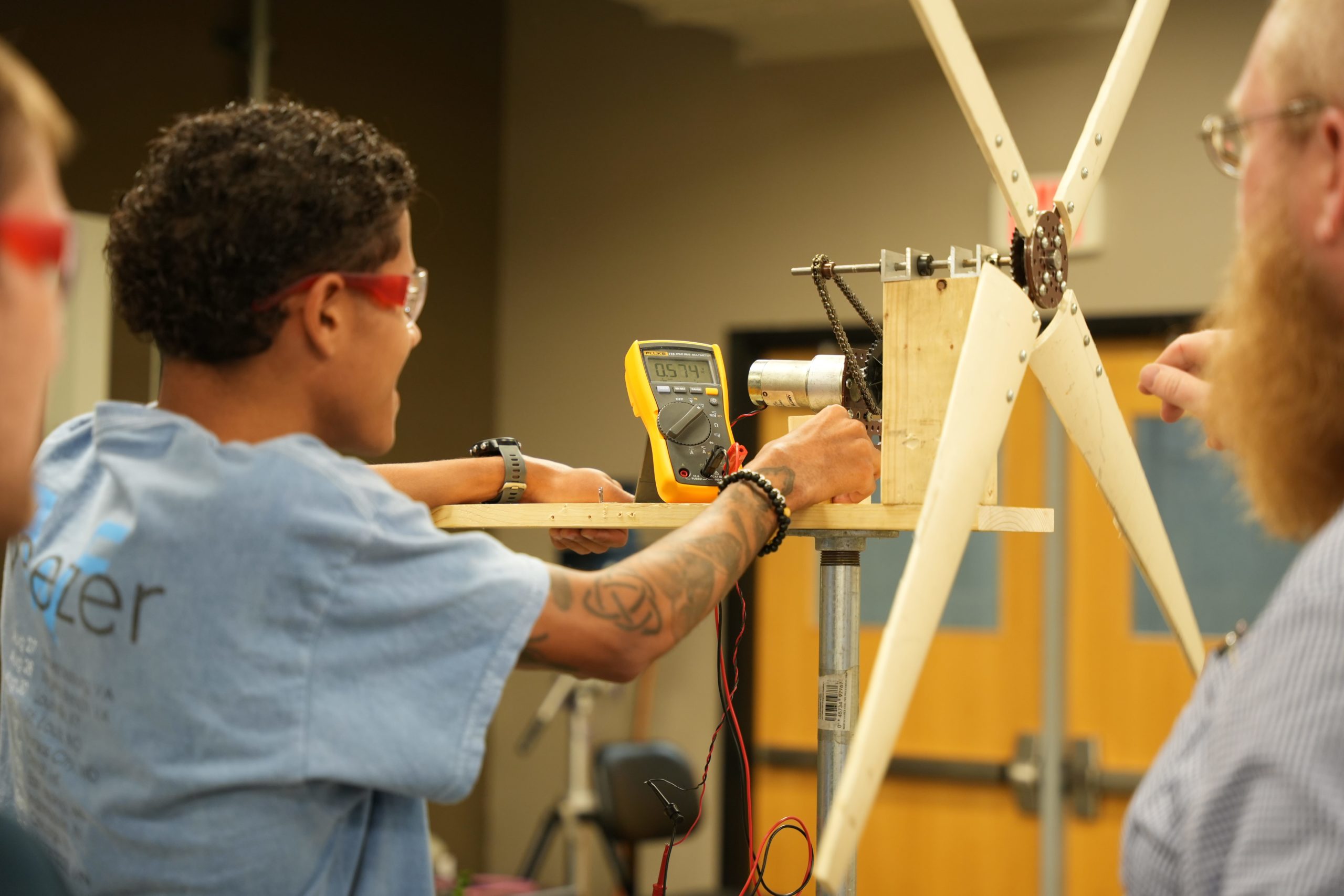
Throughout history, engineers have been among the most ingenious problem solvers in the world. Today, as technology advances faster than it ever has, the field of engineering is at the forefront of innovation, using physics, mathematics, computing, material science, and graphics to engineer solutions to some of the most vexing problems facing society. The engineering program at William Penn provides a unique opportunity, in the form of a 3+2 program of study through articulation of courses with Iowa State University leading to three major options–civil, industrial, or mechanical engineering.
As a student in the program, you’ll spend three years completing foundational mathematics, physics, computer science, and fundamental engineering courses through the Applied Technology Division at William Penn, with hands-on labs, small class sizes and dedicated professors; the Penn Core curriculum including liberal arts and a focus on leadership; plus other science courses, economics, as suggested in your major plan. The final two years are completed at Iowa State University in your chosen department, focusing on your particular application area of interest. When you successfully complete the program, you will have earned a B.A. in Applied Technology from William Penn, and a B.S.C.E., B.S.I.E. or B.S.M.E from Iowa State.
Civil Engineers
Civil engineers typically focus on the design and construction of infrastructure—airports, roads, bridges, buildings, waste water treatment plants, biosystem processing plants.
Industrial Engineers
Industrial engineers study, design, and improve integrated systems including people, materials, information, equipment and energy. This involves manufacturing processes, plant/factory operations, and increasingly incorporates the Internet of Things.
Mechanical Engineers
Mechanical engineers are broadly trained in mechanics, energy transfer and conversion, design and manufacturing, and the engineering sciences, and typically are involved in areas involving motion and the use of energy. This includes design of vehicles (automotive, aerospace, underwater), biomedical devices, manufacturing systems including robotics, power generating systems, heat transfer systems.
Careers
The engineering field is expected to achieve sustained growth through the year 2026 according to the U.S. Department of Labor, and remains one of the higher-paying career fields for college graduates. In fact, the median annual pay in 2017 was $84,770 for civil engineers and $85,880 for mechanical and industrial engineers. Employers that have hired graduates from the WPU mechanical engineering program include:
Musco Sports Lighting, LLC
John Deere
Cargill, Inc.
Vermeer Corporation
Pella Corporation
Hawkeye Pedershaab
Ajinomoto North America Inc.
Weiler Corporation
Internships
A key aspect of the engineering program is putting theory into action through hands-on learning experiences, and internships are among the best ways for that to happen. In addition to providing invaluable perspective on how knowledge is applied in a real-world professional environment, internships provide an ideal opportunity for developing professional connections and networks. Our students recently have completed internships at:
Pella Corporation
Musco Sports Lighting, LLC
Cunningham (HVAC), Inc.
Clow Valve Co.
Weiler Corporation
Van Gorp Manufacturing
Vermeer Manufacturing
City of Decatur, IL
Organizations
As a student in the program, you will have opportunities to enhance your learning experience through membership in student organizations like the Math Club or Computer Club. You’ll also have the opportunity for field trips to places like the hydroelectric plant in Ottumwa, Iowa; the Iowa Energy Center in Ankeny, Iowa; Co-Line Welding in Sully, Iowa; Chillicothe Coal-Fired Electric Plant; and the Siemens wind turbine blade factory in Fort Madison, Iowa.