
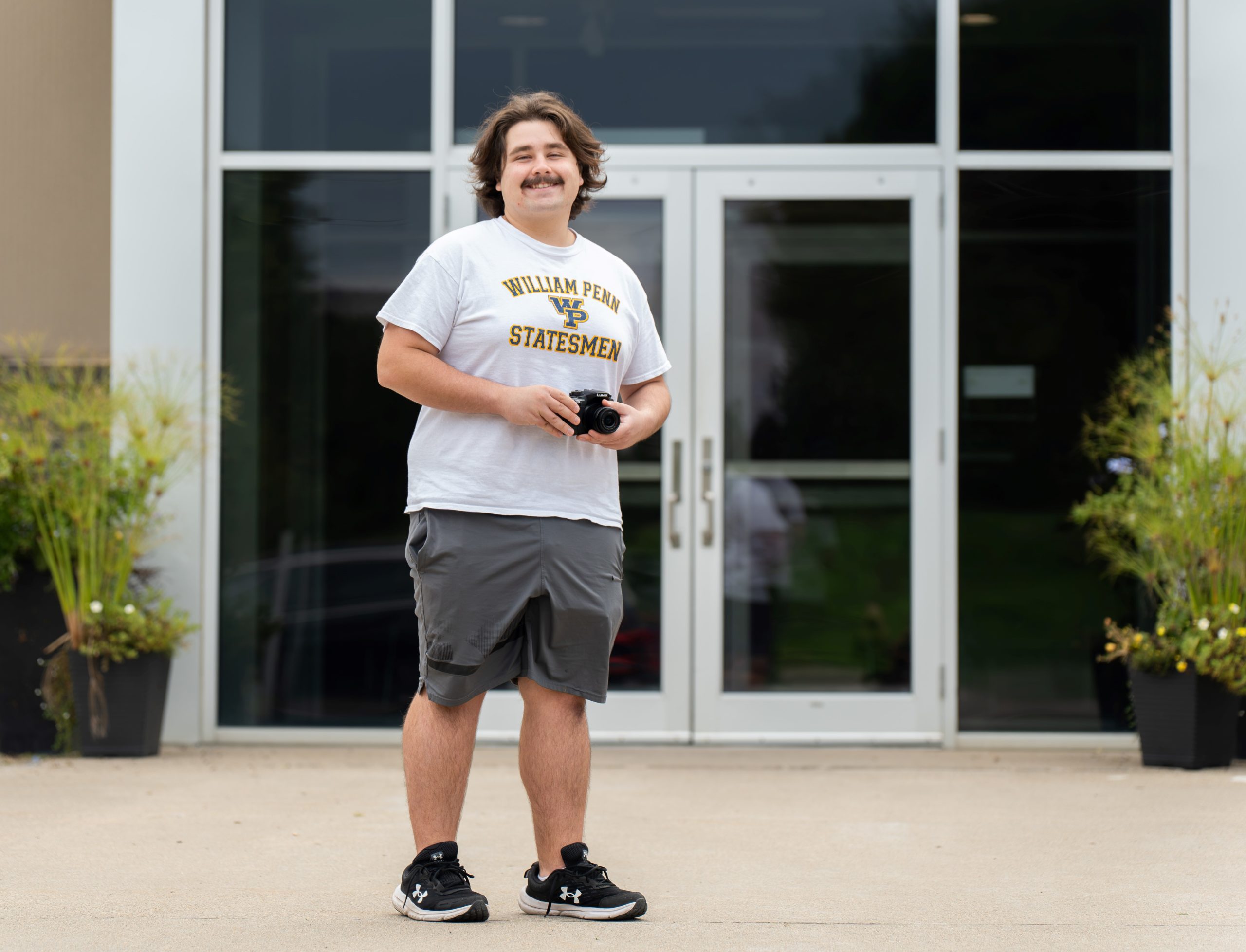
Holdin Hacker ’26
Hometown: Oskaloosa, IA
Major: New Media
For William Penn University senior Holdin Hacker, filmmaking has always been a passion. Through Penn’s New Media program, that passion has developed into technical expertise, creative leadership, and the confidence to pursue a career in the film industry.
A native of Oskaloosa, Iowa, Holdin has spent much of his life fascinated by movies and the stories they tell. From action-packed films to emotional dramas, his appreciation for filmmaking has shaped his ambition to become a film director.
When he arrived at William Penn in August 2025, however, he was still discovering what it meant to turn that passion into a profession.
Although he had experience creating videos, Holdin was unfamiliar with much of the professional equipment available to him. He also worried about fitting into a new environment where other students might have more experience.
What he found was a New Media program where students were encouraged to learn through experience, supported by classmates and faculty who wanted to see one another succeed.
“I have been able to go at my own pace when working on new projects both inside and outside of school,” Holdin shared.
That welcoming environment helped him develop the confidence to experiment with unfamiliar technology, collaborate with others, and pursue increasingly ambitious creative projects.
One of the biggest influences behind Holdin’s decision to study New Media at William Penn was Max Leonida, the University’s Film Artist-in-Residence.
Leonida’s experience working in Italy and California, along with his filmmaking career, offered Holdin an opportunity to learn from someone with professional experience in the industry he hopes to enter.
But Holdin soon discovered that the program had much more to offer.
“Beyond Max, I have fallen in love with the equipment the New Media department offers, the Black Box studio, and the endless opportunities within the school and community that will strengthen my portfolio and work experience.”
Through William Penn’s New Media program, students gain experience with professional cameras, lighting systems, audio equipment, and industry-standard editing software. More importantly, they have opportunities to apply those resources to projects that develop their technical abilities and creative judgment.
Before attending Penn, Holdin primarily used CapCut for video editing. His coursework has since introduced him to Adobe Premiere Pro and expanded his understanding of production techniques, including color grading, visual effects, audio mixing, and motion tracking.
He has also spent time learning Adobe After Effects, developing skills in animation and other advanced editing techniques.
These experiences have changed how he approaches filmmaking. Rather than focusing solely on recording and editing footage, Holdin now considers the entire production process, from developing an initial concept to organizing filming schedules and completing the final edit.
The result is a growing portfolio of work that demonstrates both his creativity and his ability to manage increasingly complex projects.
For Holdin, one of the most valuable aspects of the New Media program has been the freedom to explore his own creative interests.
His projects range from unconventional comedy to suspenseful storytelling and serious films that address difficult subjects.
One of his proudest creations, Happy Hacker’s Lunch Hour, originated from an assignment in Professor Brant Bollman’s class. What began as an unusual day-in-the-life video eventually developed into an absurd horror-comedy about a fictional children’s television host.
Holdin has also explored more serious storytelling through his short film alone., which examines a college student’s final day before suicide, and the Crazy Person Podcast, which explores mysterious events and unusual stories.
These projects reflect his willingness to experiment with different genres while developing his own creative identity.
“If anything, creating media within the New Media department has allowed me to further my voice while adding nuanced layers to those new to me and those that had known me for a long while.”
His creative growth has been accompanied by personal growth.
Initially hesitant to step outside his comfort zone, Holdin began forming friendships and participating in new experiences through the connections he made at Penn. As he became more comfortable with his classmates, he also became more willing to share his ideas and invite others to participate in his projects.
What once felt intimidating gradually became an opportunity to develop confidence and leadership skills.
Holdin’s development has been especially evident to the faculty who have worked alongside him.
Kaitlin Ardolino, Chair of New Media and Assistant Teaching Professor in the New Media Division at William Penn University, has watched his enthusiasm for creating evolve into the ability to lead projects and take greater responsibility for his work.
“As Holdin’s skills have grown and developed, his ability to be a strong project leader has also grown. I have seen him become more comfortable taking ideas and turning them into finished creative works.”
That progression reflects an important part of William Penn’s approach to New Media education. Students are encouraged not only to understand creative technology but also to develop the independence and problem-solving skills necessary to use it effectively.
“Holdin is always willing to learn and experiment. He doesn’t shy away from new equipment, software, or projects, and he is excited by opportunities to create beyond what is required in class,” Ardolino shared.
His willingness to take creative risks has helped him develop skills that extend beyond the technical side of filmmaking.
“Holdin has developed strong technical skills, but one of his biggest strengths is his creativity and problem-solving. He works well with others and can be trusted to take ownership of a project.”
For Holdin, those qualities have grown through a combination of classroom instruction, independent projects, and opportunities to collaborate with faculty and fellow students.
One particularly meaningful experience came in July 2026, when he traveled to Oklahoma City with Ardolino and other students to help produce a video for Four Star Leadership Camp.
The weeklong project provided experience working on a production outside the classroom while observing the flexibility and leadership required to complete a project.
Holdin was especially impressed by Ardolino’s willingness to take on unfamiliar challenges alongside her students.
“To me, this signifies humility, leadership, and compassion, qualities most professors don’t exhibit. She does, though, and it makes me proud to be one of her students and put my best foot forward when she needs it.”
The experience reinforced the importance of mentorship in helping students become more capable and confident creators.
While Holdin’s goal is to become a film director, the skills he has developed through New Media extend into many aspects of his life.
He has become more comfortable communicating his ideas, working with others, managing responsibilities, and approaching unfamiliar challenges with curiosity.
His experience illustrates how access to professional resources becomes even more valuable when paired with opportunities to put those resources to use.
For Ardolino, Holdin represents what students can accomplish when they are encouraged to explore their interests and take ownership of their education.
“Holdin is a great example of what can happen when students are given opportunities to create, experiment, and work on real projects. The New Media program gives students space to grow, and Holdin has really taken advantage of those opportunities.”
That combination of practical experience, creative freedom, and faculty mentorship is central to the program’s ability to prepare students for careers in a constantly evolving media industry.
Holdin encourages prospective students interested in video production and content creation to consider New Media, whether as a major or minor.
“Majoring in New Media will not only deepen their knowledge of equipment and software but also connect them with wonderful peers who will help ensure the best for their future.”
He also recommends getting involved with the Film Club, where students can explore their shared interest in movies while creating projects of their own.
With graduation approaching in May 2027, Holdin hopes to take the experience he has gained at William Penn into the film industry.
His ambition is not simply to work in filmmaking, but to establish a creative career that reflects his personality and the stories he wants to share with audiences.
Looking back on his time at Penn, he recognizes how much he has changed, both as a filmmaker and as an individual.
He describes his goal as becoming “a strong, leader who’s learned everything he can at this school while being open to the fact that he will keep garnering knowledge throughout his career as a film director and beyond.”
The student who once worried about unfamiliar equipment and finding his place is now developing original films, collaborating on productions, and taking ownership of increasingly ambitious creative work.
Holdin’s journey reflects the broader purpose of William Penn University’s New Media program: providing students with the tools, experiences, and encouragement to discover what they are capable of accomplishing.
For Holdin, that has meant more than learning how to make movies. It has meant developing the confidence to lead, the skills to bring his ideas to life, and the foundation to pursue a future doing what he loves.