
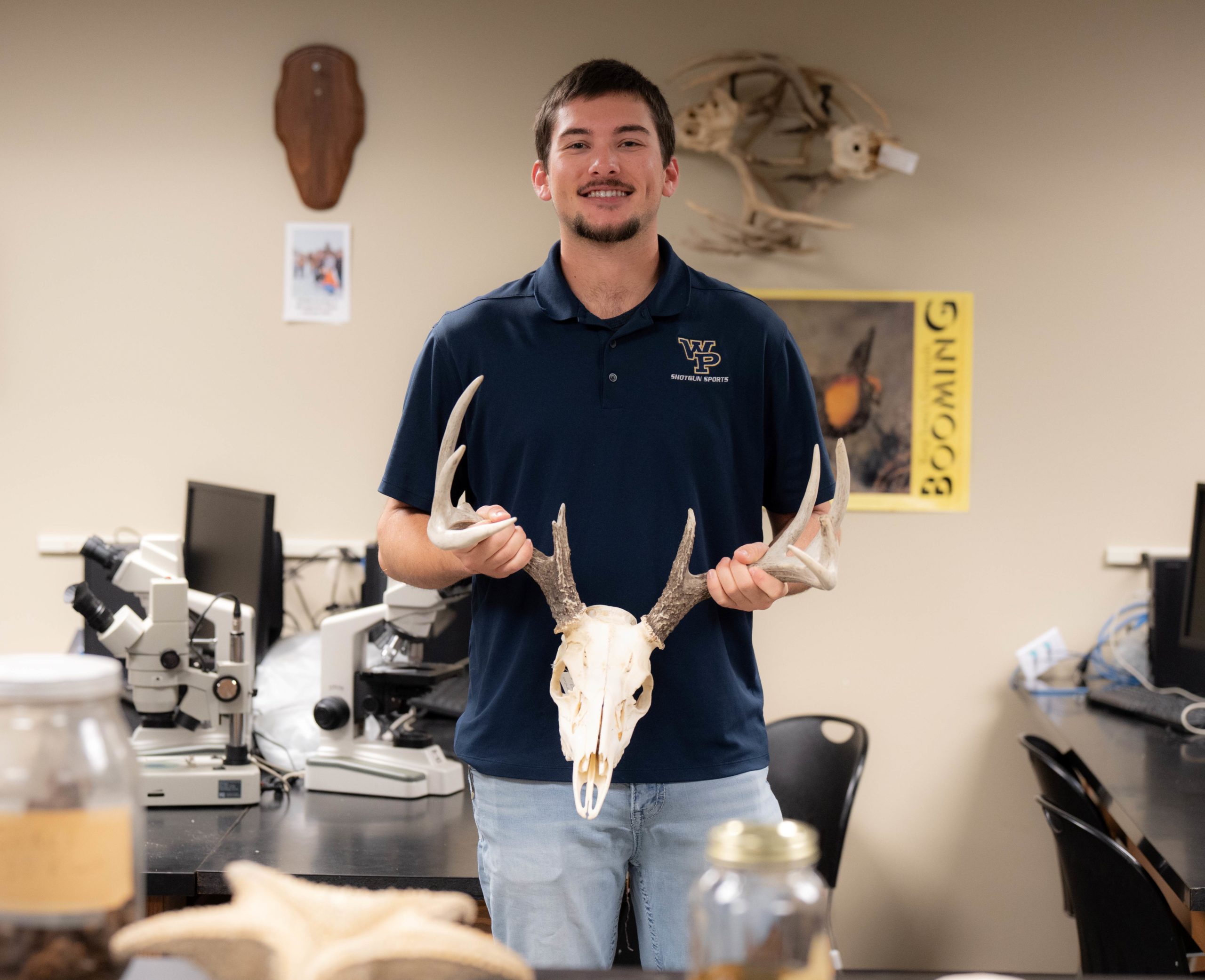
Connor Gittings ’27
Hometown: Raymore, MO
Major: Master of Organizational Leadership
Growing up in Raymore, Missouri, Connor Gittings never imagined that a social media page showcasing his shotgun sports events would chart his course to college athletics. Initially, he attended Upper Iowa University on a shotgun sports scholarship, even capturing a Division II national title in trap shooting. But after his sophomore year, Upper Iowa abruptly eliminated its Shotgun Sports program. This turning point set Gittings on a new path. William Penn University emerged as a welcoming haven for the displaced athlete. “Steve Heaton told me I could have a home here at William Penn and I took up the opportunity,” Gittings recalls of the former WPU Shotgun Sports coach who reached out when he needed a new team. Having competed against William Penn before, Gittings already knew the caliber of its program. “I first heard about William Penn from previous competitions where I had competed against them and it was evident that they were the best team in the nation,” he says. “The good-mannered and immensely skillful athletes on the Shotgun Sports team stood out to me along with the science department. I was excited to further my academics and athletic career here at William Penn”.
When Gittings arrived on campus in Oskaloosa, he immediately felt the difference. The small-town setting and tight-knit campus community made it easy to fit in. He was introduced to his new teammates with open arms and was quickly included in team activities “whether it was in or outside of school.” Unlike the bigger, more impersonal environments some universities have, William Penn’s friendly atmosphere extended beyond his sport. “People from other teams are not afraid to make friends with you, especially in the classroom,” Gittings notes, explaining how many of his closest friendships formed through group projects and lab sessions in class. He found Oskaloosa to be comfortable and convenient – “the town is not huge and overwhelming… the campus is also very close to everything in town,” he says, which helped him feel at home.
Just weeks into his first semester at William Penn, Gittings realized he had made the right decision in transferring. In those early days, the supportive professors in the Science division stood out most. “In some of my first classes in the science department, I realized the professors want to have a friendship with their students,” he remembers. “They made each of the classes much easier through their teaching and relationship with the students.” This personal approach to teaching was a game-changer. Gittings felt his instructors truly cared – they were highly knowledgeable and always willing to work with him if he had questions or conflicts. With such support from faculty and the camaraderie of classmates, “here at William Penn, the team, professors, and students all welcomed me with open arms, and I integrated very well into the school,” says Gittings. The fear and uncertainty of starting over as an out-of-state transfer quickly melted away in the warmth of the Penn community.
Gittings decided to major in Biology once he got to William Penn, a choice sparked by curiosity and solidified by inspiring coursework. “When I first came to college, I did not know what I wanted to do until I heard some of my friends talking about their biology classes,” he admits. Intrigued by their experiences, he dove into the subject and found his calling. “I love everything about the environmental side of biology, and Dr. Pete Eyheralde made it very enjoyable to learn anything related to the environmental side of biology,” Gittings says, crediting one of his professors for fueling his passion. In Dr. Pete Eyheralde’s Vertebrate Fauna course, for example, students didn’t just read about wildlife – they handled real specimens and sometimes even ventured out to collect their own. “In Dr. Pete’s class called Vertebrate Fauna we learned almost all the vertebrate animals in Iowa… and Dr. Pete never fails to make his classes interesting,” Gittings shares. Hands-on experiences like this made learning exciting and memorable, solidifying Gittings’ interest in environmental biology.
It wasn’t just the interesting classes that left an impact on Gittings; it was the professors themselves. In Dr. Pete Eyheralde, Gittings found not only an educator but a mentor and friend. “I look at Dr. Pete as a good friend since he makes good relationships with all his students and can teach anyone of any skill level,” he explains. “He’s easily been the best professor I have had. His mentorship began with the first class I had with him where he treated me like I was a familiar face.” That genuine personal connection made Gittings feel valued from day one. Even now, as a graduate student, he keeps in touch with Dr. Pete. Whenever Gittings is on campus, he makes it a point to stop by Dr. Pete’s office to chat and catch up. The bond extends beyond the classroom – sometimes into the great outdoors. Dr. Eyheralde is known for inviting students on hunting and fishing outings to share his love of nature. “He was willing to take students hunting with him to introduce them to a whole new experience,” Gittings says, noting that countless students have made “great stories and memories” on these trips with Dr. Pete. Whether in the lab or out in a field, Dr. Pete’s trademark humor and hands-on approach made learning fun and forged lasting friendships.
Through Dr. Eyheralde’s guidance, Gittings gained more than academic knowledge – he found a role model for leadership. “He gave me a real world example of how to be a good servant leader to anyone and everyone,” Gittings explains, describing Dr. Pete as “the most respectful and friendly professor a student could ask for.” More tangibly, “he also has opened many doors for career paths to me, gave me many connections, and introduced me to many people in my preferred career,” Gittings adds. Seeing the way his professor led and cared for others inspired Gittings to do the same for his peers and eventually in his own career.
On the shotgun range, Gittings also thrived as part of WPU’s powerhouse Shotgun Sports team. The transition from Upper Iowa’s program to William Penn’s was eye-opening. “I used to shoot for Upper Iowa University until they shut down the Shotgun Sports program and I transferred here to William Penn,” he says. “The program here had a much stronger and larger team. William Penn shows real appreciation for our sport like no other school I have attended had before.” Being surrounded by top-tier shooters pushed Gittings to excel, and he embraced the tight bonds formed through countless hours of practice and competition. “The friends I have made here have turned into family and I will never forget the bonds I have made here,” Gittings says of his teammates. Together, they celebrated victories, learned from losses, and supported each other’s goals.
Balancing the demands of academics and athletics was challenging, but Gittings learned to thrive through discipline and time management. He devoted himself fully to both his studies and his sport, while also carving out moments to relax and recharge with friends. This balance paid off: not only did he maintain strong grades in the classroom, he also became a leader on the shooting team. “Competing has definitely given me many insights into my leadership skills and teamwork,” he reflects. “I have learned many different ways to approach athletes as a teammate to help lead the best I can. My experience here has seriously helped me prepare for future leadership and coaching opportunities.” Indeed, by his senior year, Gittings was a mentor to younger teammates, modeling the supportive leadership he admired in his coaches and professors.
Gittings enjoyed his undergraduate experience at William Penn so much that he decided to continue his education here. After earning his bachelor’s in Biology, he enrolled in WPU’s Master of Organizational Leadership (MOL) program to further sharpen his skills. “I have liked the academic program enough to know how they treat their professors and students, and this made me want to further my education,” he explains of his decision to pursue graduate studies at Penn. He also knew that a master’s degree would give him an edge when seeking jobs with significant leadership roles. The transition to graduate school brought a different pace – with intensive 8-week courses and just one or two classes at a time – but Gittings has embraced it. “In my first semester, this program has already shaped me into a better leader and a better coach,” he says of the MOL curriculum’s immediate impact. The lessons in organizational leadership tie in perfectly with what he’s learned on the range and in the classroom, enabling him to view challenges from a higher perspective.
Now well into his graduate journey, Gittings appreciates how his time at William Penn – both undergrad and grad – has molded him. “I have learned how to be a better leader throughout my journey here at William Penn thanks to Dr. Pete, my recently retired head coach Steve Heaton, and my current coach Colten Uitermarkt,” he shares. Each mentor taught him something unique: Dr. Pete through academics, Coach Heaton by recruiting him and supporting his development, and Coach Uitermarkt by guiding the team day-to-day. Equally important, Gittings says, are the lessons learned alongside his peers. “My teammates have all shaped me into a better teammate, friend, and leader as well through all the ups and downs of my collegiate career,” he notes. In true William Penn spirit, the community around him continually pushed him to grow as a student and as a person.
As graduation draws near once again, this time with a master’s degree, Gittings is setting his sights on a future where he can pay forward the mentorship he received. “I would love to get into a leadership position in either conservation and/or Shotgun Sports, like coaching a team or running a gun club,” he says, outlining his career aspirations. Whether he ends up leading wildlife conservation efforts or coaching the next generation of collegiate shooters, he feels ready for the challenge. His confidence comes not only from the credentials he’s earned, but from the network of supporters he’s gained. “The people I have surrounded myself with have opened many doors for me, whether they were temporary opportunities or ones I will cherish for life,” Gittings affirms. Professors, coaches, teammates, and friends have all become part of his extended Penn family, and he knows their influence will continue long after he leaves campus.
Reflecting on the remarkable path that brought him to this point, Gittings has no doubts that transferring to William Penn was the best decision he could have made. “I think my journey has been amazing… it has brought no regret,” he says. “I would have missed out on meeting my closest friends, greatest coaching experiences, and some of the best memories a kid could have made” if he hadn’t come to Penn. It’s a journey that took courage to begin, but one that has been richly rewarding in the end. For other students considering a similar leap of faith, Gittings offers wholehearted encouragement. “This place has open arms everywhere… The professors will make you feel at home as well,” he advises fellow transfer students, emphasizing William Penn’s inclusive spirit. The myriad clubs and organizations on campus are, in his experience, “all just good groups of friends.” And thanks to “the smaller class sizes” at WPU, “you foster great relationships with your professors and fellow classmates,” Gittings says – relationships that can last a lifetime.
Ultimately, it’s those relationships that mean the most to Connor Gittings. Ask him what he’ll remember years from now about William Penn University, and the answer comes easily. “The friends I have made along the way – whether it be my professors, coaches, teammates, or classmates,” he reflects, “will be what I remember most about my time at William Penn.”